by Braelei Hardt
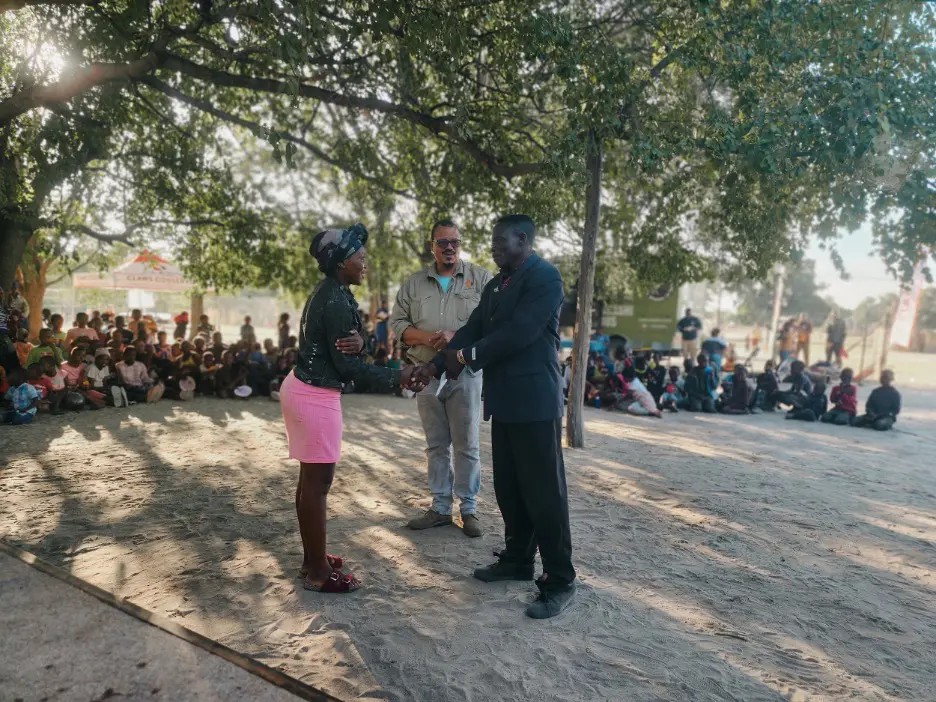
A local woman receives recognition for winning a storytelling contest at CLAWS’ First Annual World Lion Day. Credit: Andy Maano
The air in the Okavango feels alive. Even in the still heat of the afternoon, it shimmers and hums with its own pulse. The soft click of cicadas, the distant chatter of vervet monkeys, and the low groan of cattle wandering home through trodden dust make a constant backdrop. Every breath carries the earthy tang of rain that never comes. In the mornings, I wake to the sound of cowbells and laughter, the rhythmic sweep of brooms against sand, and the scent of smoke from cooking fires curling through the air. Nights are cool and alive with the yips of hyenas, the agitated grunts of wallowing hippos, or worse– the uneasy silence that settles when something predatory moves unseen beyond our tents.
Officially, I had come to Botswana as part of CLAWS’s World Lion Day celebration to assist the local team and serve as a liaison for my own team’s organization, EWCL. Despite the nobility of my mission, I’d be lying if I said I hadn’t come for the same reason many do: to see lions. Like most Americans raised on BBC documentaries and big-cat calendars, I carry a quiet, lifelong reverence for the King of the Jungle. Even as a seasoned wildlife biologist trained to think beyond charisma and toward ecosystems, I could never quite resist the hope of meeting such an icon face-to-face. To walk through a landscape where lions still roam freely feels like a pilgrimage of sorts; a return to something primal, powerful, and rare that every conservationist secretly desires.
Working academically in conservation teaches you data, trends, and policy, but it can’t replace the lived experience of sharing a landscape with the species you study. By now I had read countless reports detailing population declines, the tragedies of retaliatory poisonings, and the economic toll borne by herders after losing livestock. But none of those numbers ever carried weight in my chest the way a local might carry it. To me, they were just lines in a report: informative, but distant.
CLAWS understands this conundrum better than most. The organization’s strength lies in its foundation of community: most of their staff are local to target villages, including those in leadership, and their approach to lion conservation tends to begin with listening. They do not march in as outsiders demanding that wounded locals stop killing lions because the world likes them. Instead, they collaborate with those who live beside lions. A partnership grounded in empathy, built on the understanding that coexistence only thrives when everyone has a voice.
These philosophies had guided the decision to launch World Lion Day: a cross-village event bringing folks together in celebration of coexistence with lions. Under a canopy of sun-faded tarps, children paint lion masks while elders gather in the shade to share stories of encounters both harrowing and heroic. CLAWS herders demonstrate the use of tracking collars and their lion alert system using volunteers from the crowd, showing how technology can protect both cattle and carnivores. Music drifts through the air, and my body can’t help but move along as I stand behind a small booth at the edge of the dancefloor.
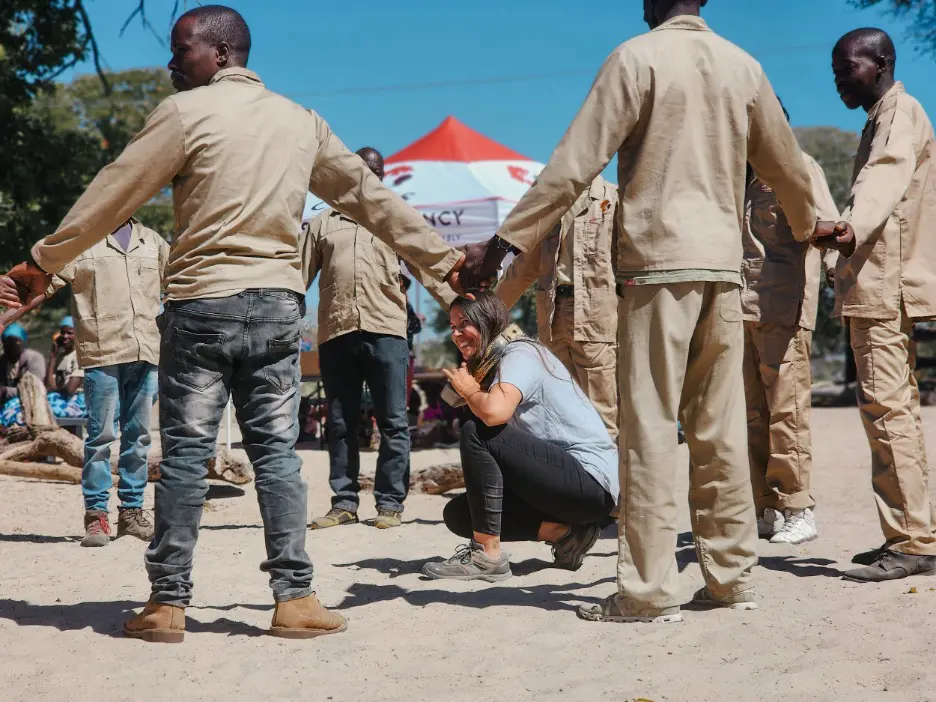
CLAWS staff demonstrates the principles of lion tagging and geo-fencing to World Lion Day participants. Credit: Andy Maano
Toward the center of the celebration, a group of local performers gather on a makeshift stage of packed earth for a community theatre piece. They act out the story of a herder who saves his cattle not with weapons or traps but with vigilance, ensuring his cattle’s safety simply by keeping watch over them. The crowd gasps as the ‘lion’ prowls the edge of the dirt stage, and laughs when, while the herder sleeps, the lion tackles a woman playing a cow to the ground. They laugh again when in the story, the next night, the lion is easily scared away by the now-vigilant herder. It’s storytelling at its most immediate and alive, rooted in the traditional performances that once inspired the stylized movements of The Lion King Broadway production.
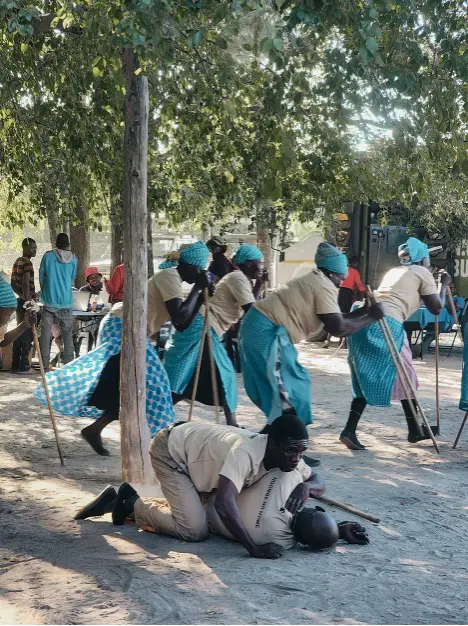
A ‘lion’ attacks one of the ‘cattle’ during the live performance. Credit: Andy Maano
I, as an outsider, now have the incredible opportunity to engage in this rich culture. I speak with locals of all ages about their families, stories, and desires. The litany of statistics I’ve read, suddenly given context. One man tells me that his father had been mauled by a lion many years ago, and he had taken revenge, of course. I ask if revenge helped ease the pain of his father’s death, and he nods without hesitation. Life for a life, he says, as if it’s the most natural thing in the world. Later, a young boy tells me he admires lions for their power and bravery, that he wants to be like one someday. A beast able to protect his family and his home with ferocity.
“Which is your favorite, then?” I ask the boy, gesturing to the rows of glossy cards spread across the small plastic table between us. I had created these cards for the event; each bore the image and story of a lion currently tracked by CLAWS.
“Mariri,” he says after a moment, fingers resting lightly on the photo of a big male with a thick, dark mane. “He looks strong,” the boy explains when I tilt my head, “like he can protect everyone.” His friends nod in agreement, their eyes lingering on the lion’s image as though drawing courage from it.
I ask the same question of everyone who stops by my booth, and over the days a pattern emerges. Women with large families often choose Dyombotiyenda, known for her patience and care. Older men favor Kurandakure, the even-tempered lioness who keeps to herself and avoids trouble. Teenagers grin and point to Twashwena, the mischievous young male with a reputation for slipping past boundaries. Each choice feels like a mirror, a reflection of the chooser’s own hopes, burdens, and humor.
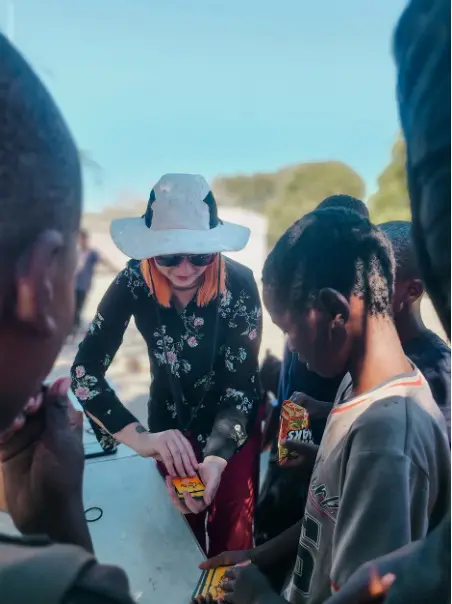
The children of Beetsha learn to play a simple game using CLAWS’ lion cards. Credit: Andy Maano
The idea behind these cards had been to build familiarity with the lions that share the peoples’ space, knowing–scientifically and intuitively–that familiarity breeds empathy. As I pass out decks of the cards to children and adults alike, I wonder, and hope, that their relationship to the lions might become more personal, and therefore more positive. Having your ‘favorite’ lion slaughtered in retaliation feels profoundly different than hearing of just any lion’s death, after all.
As we pack up our supplies at the end of the event, the air hums with a mix of exhaustion and joy. Months of preparation, good-natured pivoting, and hard work finally come to a close. We are all sunburned, dust-streaked, and grinning.
For my contribution, I’m offered a private safari through the Okavango, a chance to finally see the lions I had come to protect. Our vehicle breaks down an hour in, of course. In the time that remains, I see elephants, giraffes, and wild dogs with fresh pups… but no lions.
The me who had arrived in Botswana would have been crushed by this. The me who leaves smiles instead. I realize I haven’t really come for lions at all, but for the people who live alongside them–their stories, their humor, their strength. What I found here was something quieter but far more enduring than the roar I came seeking: a reminder that conservation lies not in the gratification of preserving rare beasts, but in the hands that learn to live with them.